



10 February, 2026
Robotic cardiac surgery at barnaclínic+: a consolidated program with 11 interventions performed in 2025
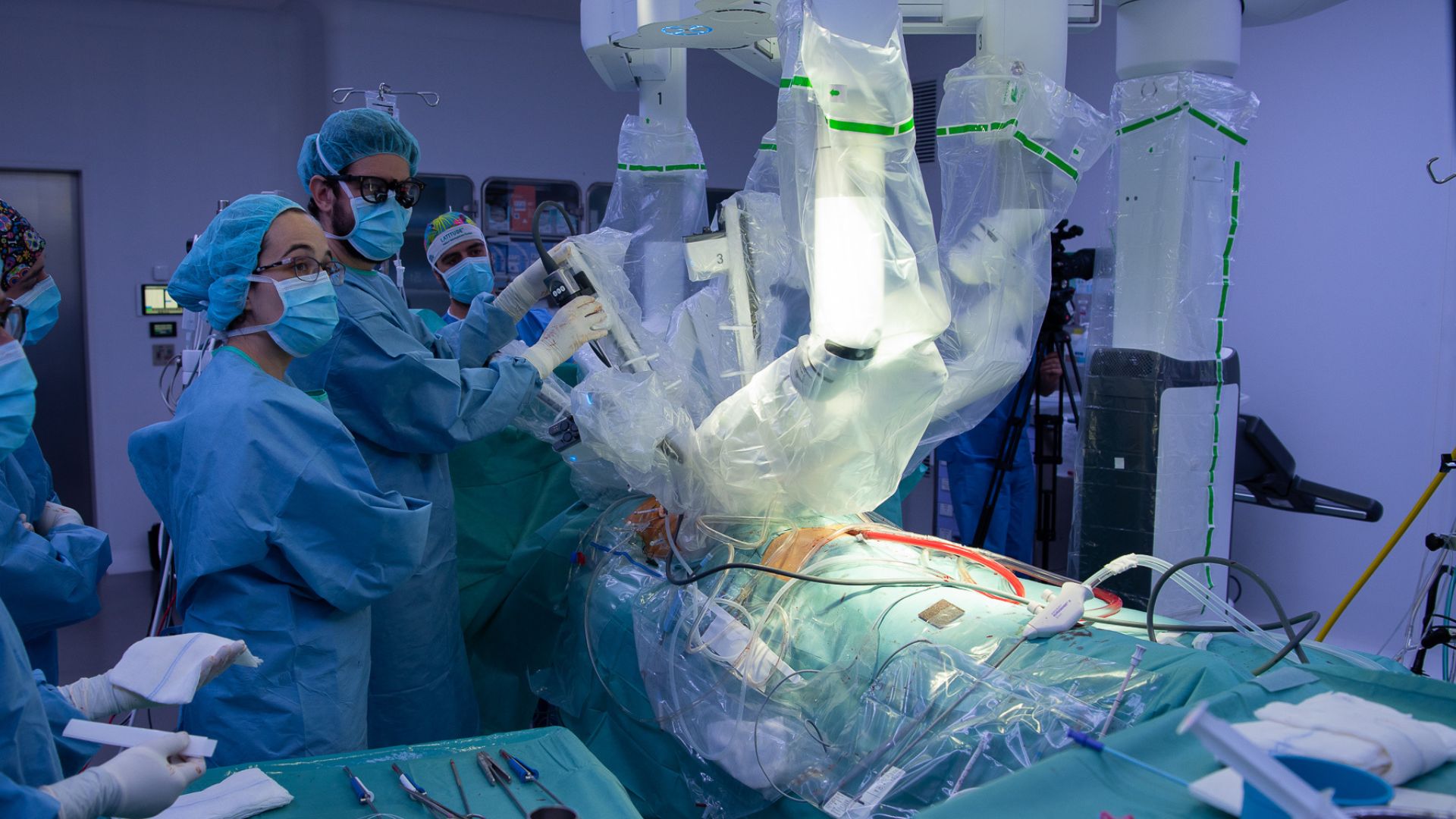
The robotic cardiac surgery is today one of the most advanced forms of minimally invasive cardiac surgery, making it possible to treat complex heart conditions with the same effectiveness as conventional surgery, but with significantly less surgical trauma. In this context, barnaclínic+ performed 11 robotic cardiac surgeries throughout 2025, integrating this highly complex technique into its private clinical activity.
These procedures were carried out by a team with extensive experience in robotic cardiac surgery, which has accumulated more than 400 procedures performed and is currently considered one of the reference teams in Europe in intracardiac robotic cardiac surgery.
Robotic cardiac surgery: precision and control at the service of the surgeon
Robotic cardiac surgery is performed using a high-precision robotic surgical system, connected to the patient and entirely controlled by the surgeon from a console located in the operating room. The robot does not act autonomously; instead, it precisely replicates the surgeon’s movements, allowing work inside the heart with instruments measuring only a few millimetres.
As Dr. Daniel Pereda explains, the robot is a telemanipulation system that enhances the surgeon’s capabilities in very small anatomical spaces, where precision and mobility are crucial.
“The robot simply replicates the commands given by the surgeon from the console”
Dr. Daniel Pereda, cardiovascular surgeon at barnaclínic+

You may be interested in…
· Robotic and minimally invasive cardiac surgery at barnaclínic+
· Hospital Clínic Group, the first in Spain to perform robotic cardiovascular surgery
Operating on the heart without opening the sternum
One of the main advances of robotic cardiac surgery is the possibility of performing complex heart operations without opening the sternum, accessing the interior of the heart through small incisions between the ribs.
This approach avoids conventional sternotomy and makes it possible to maintain full mobility of the surgical gesture even inside the heart, something that is difficult to achieve with other minimally invasive techniques.
“We can perform the same procedure without having to open the sternum, introducing all the instruments and the robot’s camera between the patient’s ribs through very small incisions”
Dr. Daniel Pereda, cardiovascular surgeon at barnaclínic+
You may be interested in…
· Port Access Surgery: minimally invasive cardiovascular surgery
The same surgical outcome, with much less trauma
The goal of robotic cardiac surgery is not to change the result of the operation, but to achieve the same surgical objective while significantly reducing trauma to the patient. Avoiding opening the sternum results in less postoperative pain, a lower risk of bleeding and transfusions, fewer wound complications and a clearly faster functional recovery.
As Dr. Pereda points out, the clinical benefit is evident and sustained over time.
“We achieve the same result with much less surgical trauma, which translates into safety and, above all, easier recovery”
Dr. Daniel Pereda, cardiovascular surgeon at barnaclínic+
Faster recovery and shorter hospital stay
Thanks to this minimally invasive approach, many patients undergoing robotic cardiac surgery experience a significantly faster recovery than with conventional surgery. In many cases, time in the ICU is minimal or even unnecessary, and hospital discharge usually occurs between the third and fourth day after the operation.
Within one or two weeks, patients can resume an almost normal life, compared with the several months of recovery that may be required after conventional cardiac surgery.
11 robotic cardiac surgeries at barnaclínic+ during 2025
The 11 robotic cardiac surgeries performed at barnaclínic+ during 2025 were individually indicated, applying this technique when it truly offers a clear clinical benefit for the patient.
The growth of this activity is due to the progressive expansion of indications to more pathologies and more patients, especially in conditions such as mitral valve or tricuspid valve disease, where robotic surgery has become the reference approach whenever there is no specific contraindication.
More than 400 robotic surgeries performed: experience makes the difference
The team responsible for these procedures has already exceeded 400 robotic cardiac surgeries, a volume that allows processes to be optimised, interventions to be standardised and the technique to be offered with greater safety guarantees.
As Dr. Pereda explains, accumulated experience is key to refining every step of the procedure and directly benefiting the patient.
“To date, we have already performed more than four hundred robotic cardiac surgery procedures”
Dr. Daniel Pereda, cardiovascular surgeon at barnaclínic+
The best moment for minimally invasive cardiac surgery
The combination of mature technology, accumulated clinical experience and a long tradition in minimally invasive cardiac surgery places robotic surgery at a particularly favourable moment.
In Dr. Pereda’s own words, “we are at the best moment in history for minimally invasive cardiac surgery”, a statement reflected in the consolidation of stable clinical programmes and the progressive expansion of indications.
The 11 procedures performed at barnaclínic+ during 2025 reflect this reality: robotic cardiac surgery applied with sound judgement, proven experience and a clear focus on minimal invasiveness, always with the goal of offering patients the best possible therapeutic option.