



You can make an appointment with the barnaclínic+ FASD Unit online. Once you have made your request, we will contact you, attempting to take your preferences into account as much as possible.
THE UNIT
The FASD unit has specific expert equipment for the diagnosis and monitoring of Foetal Alcohol Spectrum Disorder, including clinical guidelines for parents and schools, an app for clinical diagnosis, etc.
Leaded by Dr. Oscar García-Algar, it is the only unit of its kind in Spain and it works directly (under the umbrella of BCNatal) with the staff at Hospital Sant Joan de Déu, where its other premises are located.
TEACHING AND RESEARCH
In addition to the clinical aspect, the unit carries out FASD teaching activities and research. Our clinical research group - Grup de Recerca Infància i Entorn (GRIE) - has more than 15 years of experience on the subject and is a national and international leader in clinical research on alcohol exposure during pregnancy.
We are the main national FASD clinical research group, with public and private funding, covering 4 main lines of research: clinical care, basic research, clinical trials with therapeutic candidates, animal models on the effects of prenatal exposure to alcohol on neurodevelopment.
TREATMENT LINES
What is FASD?
Alcohol is one of the most teratogenic substances and its consumption during pregnancy may lead to a wide range of adverse effects on the developing foetus. Prenatal exposure to alcohol causes dysfunction of the central nervous system (CNS) due to structural and functional brain damage.
In some cases these structural changes may be viewed using Magnetic Resonance Imaging, the most common being microcephaly, reduction in the volume of white and grey matter, malformation and agenesis of the corpus callosum, reduction in the volume of the caudate nucleus, hippocampus and the frontal, temporal and parietal lobes.
The severity of the damage due to prenatal exposure to alcohol depends primarily on the dose consumed and the time and pattern of consumption, as well as individual genetic susceptibility.
Hence, Foetal Alcohol Spectrum Disorder (FASD) groups the following conditions into various clinical forms: Full Foetal Alcohol Syndrome (FAS), partial FAS, alcohol-related birth defects (ARBD) and Alcohol-related neurodevelopmental disorder (ARND).
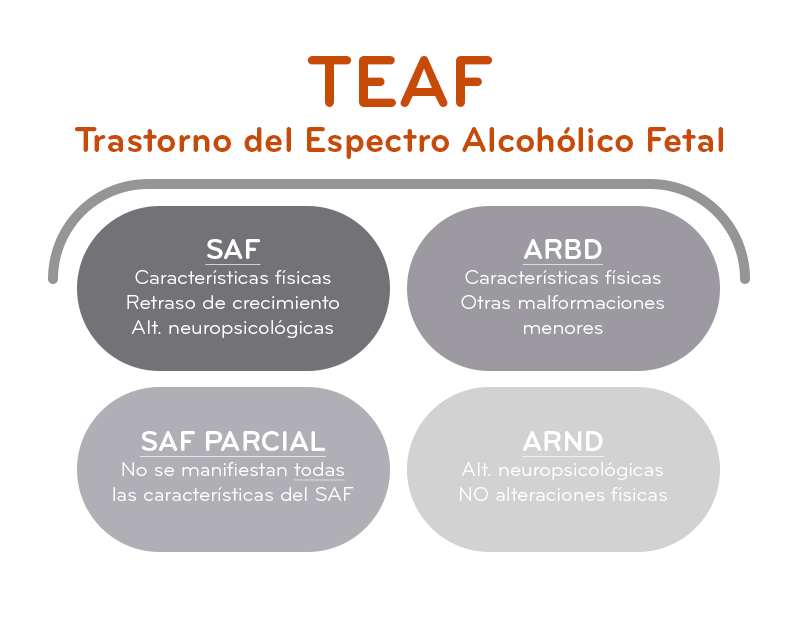
Symptoms of FASD
Foetal Alcoholic Spectrum Disorder merely describes a series of clinical conditions that make it possible to diagnose the damage caused by prenatal alcohol. FASD itself has no specific treatment, since it is syndromic.
Even so, no single cognitive profile pattern has been identified that can be considered prototypical; some of the disorders that are more common in children with FASD include involvement of working memory, emotional management difficulties and theory of mind deficits.
At a clinical level, these difficulties result in various degrees of signs and symptoms such as attention deficit and hyperactivity disorder (ADHD), academic failure, mental retardation, problems reading and writing, behavioural problems, etc., although all of these are not always presented or with the same intensity. Each child with FASD has a different neuropsychological and behavioural profile.
Treatment of FASD
Treatment of Foetal Alcoholic Spectrum Disorder is mainly psychological (cognitive-behavioural), logopedic, educational and, in exceptional circumstances, pharmacological (always symptomatic, as there is currently no specific FASD treatment for the underlying FASD lesion). The family must always be offered psychological support. The comprehensive follow-up of patients is conducted using several types of visit: pre-adoption, post-adoption, diagnostic, follow-up, case studies, coordination with professionals and resources.
OUR OFFER
FASD PACK |
|
|
1. Pre-adoption: initial visit prior to adoption which includes general information about adoption, risks, evaluation of reports, images, videos, etc., and counselling prior to adoption |
60 min. |
|
2. Post-adoption: basically, this is the visit after adoption, almost exclusively for confirmation or exclusion of the FASD diagnosis, which includes an evaluation of the reports, physical assessment, psychological tests, devolution tests, etc., focus of follow-up, coordination with professional |
60 min. |
|
3. Diagnosis of FASD: Includes prior, psychologist, paediatric and devolution visits, as well as coordination with professionals. |
120 min. |
FIRST VISIT |
|
|
1. Psychology |
90 min. |
|
2. Non-specific assessment: for example, second opinion, first post-diagnosis visit after diagnosis of FASD, etc. |
60 min. |
|
3. Post-adoption |
60 min. |
FOLLOW-UP VISIT |
|
|
1. Psychology (weekly, fortnightly or monthly) 2. Non-specific assessment 3. Coordination (school, professionals, etc.) |
60 min. |
You can make an appointment with the barnaclínic+ FASD Unit online. Once you have made your request, we will contact you, attempting to take your preferences into account as much as possible.
How to arrive
Blog
Obesity and heart failure: what changes with the new European indication for tirzepatide
March 4, World Obesity Day, is an opportunity to remember that obesity is not an aesthetic issue but a complex chronic disease with a direct impact on metabolic and cardiovascular health. In this context, the recent extension of the European indication for tirzepatide —the active ingredient of Mounjaro— in patients with obesity and heart failure […]
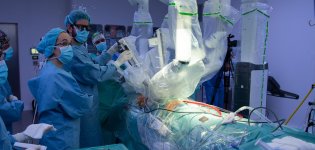
Robotic cardiac surgery at barnaclínic+: a consolidated program with 11 interventions performed in 2025
The robotic cardiac surgery is today one of the most advanced forms of minimally invasive cardiac surgery, making it possible to treat complex heart conditions with the same effectiveness as conventional surgery, but with significantly less surgical trauma. In this context, barnaclínic+ performed 11 robotic cardiac surgeries throughout 2025, integrating this highly complex technique into […]
barnaclínic+ addresses electroporation as a new treatment for atrial fibrillation on the “Salud (t) Plus” podcast
Following the first episode of “Salud (t) Plus”, the barnaclínic+ podcast that launched the format with the real-life experience of Ares Teixidó, who shared how she has learned to live with type 1 diabetes, this new episode focuses on electroporation, an innovative treatment for atrial fibrillation, one of the most common cardiac arrhythmias. Through a […]