



15 October, 2026
barnaclínic+ explores lumbar disc herniation and endoscopic spine surgery in the fifth episode of “Salud (t) Plus”
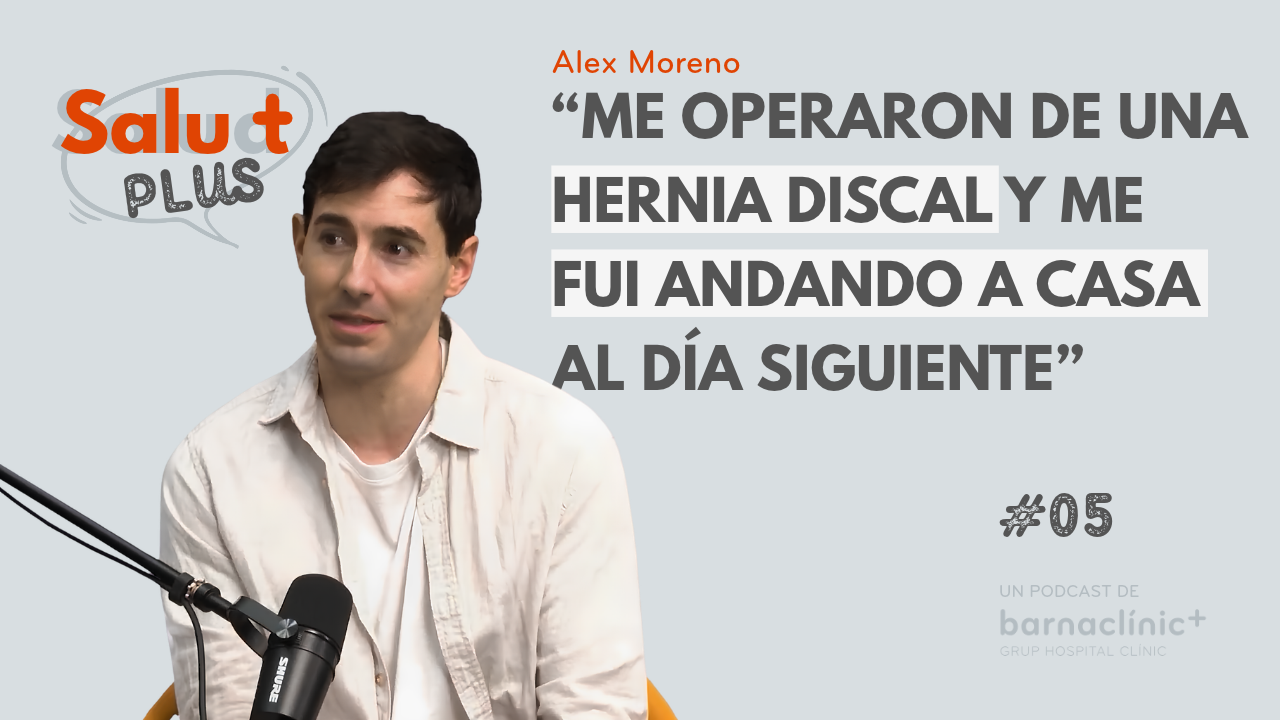
Following the previous episodes of “Salud (t) Plus”, the barnaclínic+ podcast that shares real health experiences through the voices of patients and professionals, this fifth episode focuses on lumbar disc herniation, a spinal condition that can cause lower back pain and leg pain, and on endoscopic spine surgery, a minimally invasive technique to treat it.
The episode features Àlex Moreno, who was injured while doing sport and lived for six months with pain that stopped him from leading a normal life, until he decided to have surgery. He is joined in the conversation by his partner, Esther Tacons, and Dr. Abel Ferrés, neurosurgeon at barnaclínic+.
“I put up with it for six months out of fear. Now I realise I could have had surgery much sooner”
Àlex Moreno, barnaclínic+ patient
What is a lumbar disc herniation and why does it happen?
Àlex suddenly felt a pain he had never experienced before, so intense that he fell to the ground and ended up in A&E. He had pain in his lower back and all the way down his leg: his sciatic nerve was compressed. For months he tried physiotherapy, osteopathy and acupuncture, but the pain did not go away.
As Dr. Abel Ferrés explains, in spinal conditions “everything starts with the disc”. The disc is the structure that supports the body’s weight between the vertebrae. Over the years, and due to genetic factors, it gradually dehydrates and its outer fibres weaken. If one of them tears, for example when lifting something heavy or doing sport, part of the disc’s core can push out and compress the nerves: this is a lumbar disc herniation.
If this wear-and-tear process progresses, it can lead to other conditions, such as spinal canal stenosis or spondylolisthesis, when one vertebra slips over another.
“What concerns us most is not so much the pain, but that the nerve becomes damaged and leaves a neurological deficit in movement or sensation”
Dr. Abel Ferrés, neurosurgeon at barnaclínic+
You may be interested in…
Endoscopic lumbar surgery: minimal aggression, maximum effectiveness
When is surgery indicated for a lumbar disc herniation?
In most cases, surgery is the last resort. The exception is a neurological deficit: when the patient has difficulty moving the foot or part of the leg, problems with sensation or with bladder or bowel control, surgery becomes the first option.
When the problem is leg pain caused by nerve compression, the usual approach is to wait between four and eight weeks. According to Dr. Ferrés, after eight weeks the chances of improving spontaneously or with conservative treatment decrease, and that is when surgery can offer the most benefit. For lower back pain without nerve involvement, surgery should always be the last option.
“Don’t have surgery without the right indication. With a good indication and good surgical execution, the benefits are significant and the risks are really low”
Dr. Abel Ferrés, neurosurgeon at barnaclínic+
Endoscopic spine surgery: the same effectiveness through a minimal incision
Dr. Ferrés stresses that endoscopic surgery “is surgery”: through the endoscope, the surgeon performs the same procedure as with microsurgery, but through an incision of between 7 millimetres and one centimetre. This causes less damage to the skin and muscle, and the surgeon works inside a small bubble of water that allows them to see the area.
According to the specialist, this technique achieves the same effectiveness as conventional surgery, with a very low risk of infection thanks to continuous irrigation and a lower risk of instability, because muscles and ligaments are preserved. It is a minimally invasive technique, but not a simple one: it requires a learning curve that the team has completed in order to offer it with full guarantees.
A fast recovery and support at home
One of the goals of these techniques is for the patient to sit up and walk within 24 hours. In Àlex’s case, an hour and a half after waking up the physiotherapists helped him take his first steps, and the next day he went home. Within a week he was back at work and, three and a half weeks after the procedure, he was leading a normal life.
Esther recalls that at first they thought the pain would go away on its own. But after the appointment where endoscopic surgery was explained to him, Àlex was clear: he wanted to have this technique, and with Dr. Ferrés.
“I’ve got my enthusiasm back”
Àlex Moreno, barnaclínic+ patient
“Salud (t) Plus”: a human and real look at health
With this episode, “Salud (t) Plus” continues to reinforce barnaclínic+’s commitment to person-centred medicine, combining medical innovation, scientific rigour and real-life experiences. If you missed the previous episodes, find out how an insulin pump changed Ares Teixidó’s daily life, what electroporation for atrial fibrillation involves, how facial paralysis after an acoustic neuroma is treated, or what ICL lenses for keratoconus are.
Listen to the fifth episode of “Salud (t) Plus” on Spotify:
Salud (t) Plus: our health podcast
Discover real-life experiences from barnaclínic+ patients and healthcare professionals about medical conditions, innovative treatments and medical advances. Stories of health, resilience and recovery told in the first person.
Living with type 1 diabetes and the insulin pump revolution: Ares Teixidó’s story
Ares Teixidó shares her experience of living with type 1 diabetes and how an insulin pump with a closed-loop system has transformed her life. Together with Dr Jesús Blanco and Montse Granados, we explore the latest advances in diabetes treatment.
Atrial fibrillation and a new life after pulsed field ablation: Montserrat’s experience
Montserrat Bel explains how she regained her quality of life after undergoing treatment for atrial fibrillation using pulsed field ablation. Dr Ivo Roca and Dr Andreu Porta explain this innovative cardiac ablation technique.
Acoustic neuroma and facial paralysis: “They saved my life. Then they gave me back my smile”
Yolanda shares her experience with an acoustic neuroma, from brain surgery to rehabilitation for facial paralysis. Dr Jorge Torales and Dr Sandra Vázquez explain the key aspects of treatment and recovery.
ICL surgery makes Josep’s dream of becoming a firefighter come true
Josep explains how refractive surgery with ICL implantable lenses helped improve his vision despite having keratoconus. Dr Josep Torras and Patricia Martín explain this alternative to laser eye surgery.
Spine surgery allowed Àlex to walk and play sports without pain again: “I put up with it for 6 months because I was afraid of surgery”
Àlex shares his first-hand experience after suffering a lumbar herniated disc that caused severe back pain and sciatica for months. Together with his partner, Esther, and Dr Abel Ferrés, a barnaclínic+ neurosurgeon specialising in minimally invasive spine surgery, we look back at the entire process.