



8 October, 2026
barnaclínic+ explores refractive surgery with ICL lenses in the new episode of “Salud (t) Plus”
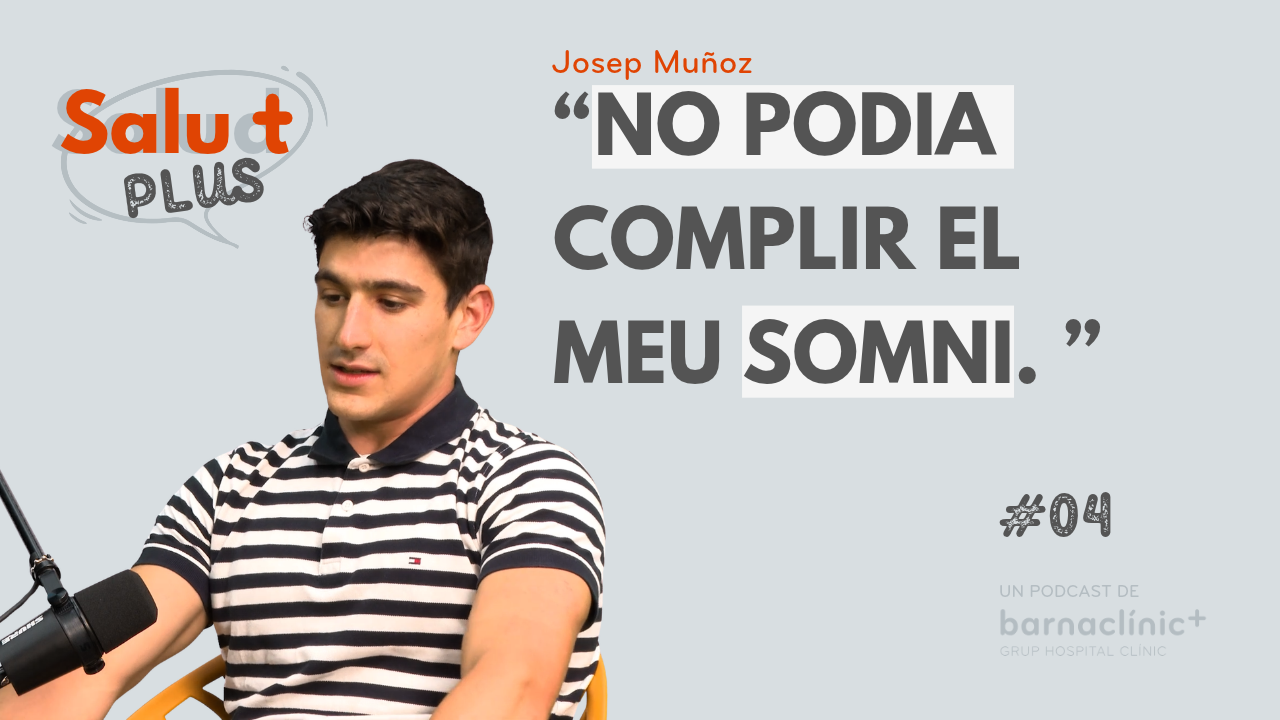
To mark World Sight Day, “Salud (t) Plus”, the barnaclínic+ podcast that shares real health experiences through the voices of patients and professionals, releases its fourth episode. This time it focuses on refractive surgery with ICL lenses, an alternative to laser surgery for correcting vision.
The episode features Josep Muñoz Irimia. Although refractive surgery is often thought of as a single solution for everyone, every case is different, and Josep’s was a special one: he had keratoconus in his left eye, a corneal condition that ruled out laser surgery. He is joined in the conversation by his father, Antonio Muñoz; Dr. Josep Torras, ophthalmologist specialising in cornea and refractive surgery at visiõnclínic; and Patricia Martín, optometrist specialising in refractive surgery at visiõnclínic.
“I’ve always dreamed of being a firefighter, but I couldn’t pass the medical requirements. Now my life has completely changed”
Josep Muñoz Irimia, barnaclínic+ patient
What are ICL lenses and why are they an alternative to laser surgery in keratoconus?
When people think of refractive surgery, they usually think of laser surgery on the cornea. But in keratoconus, a condition in which the cornea becomes thinner and misshapen, laser surgery is contraindicated.
“Keratoconus causes irregular astigmatism that often can’t be fully corrected with glasses or conventional contact lenses,” explained Dr. Josep Torras. In Josep’s case, the solution was to implant a phakic intraocular lens, specifically an ICL lens.
“It’s a very thin lens made of a biocompatible material, placed just behind the iris and in front of the natural lens. And it’s a reversible technique: if there’s a problem, it can always be removed or replaced”
Dr. Josep Torras, ophthalmologist specialising in cornea and refractive surgery at visiõnclínic
You may be interested in…
What are scleral lenses?
A thorough preoperative assessment to tailor each case
Before surgery, the team carries out a very comprehensive eye assessment. “We measure the thickness of the cornea, its curvature and shape, tear quality and how the eye reacts to light,” explained Patricia Martín.
Not every eye is suitable for an ICL lens. According to Dr. Torras, the eye’s anterior chamber must be wide enough and the endothelium, the cells that keep the cornea transparent, must be healthy. The professionals agreed that the key is to personalise treatment and understand what each patient expects.
What ICL lens surgery and recovery involve
The procedure is performed under topical or local anaesthesia with sedation, without general anaesthesia. Each eye is operated on separately, through a small incision of around 3 millimetres. Afterwards, the patient uses antibiotic and anti-inflammatory eye drops for about a month, and the eye is checked a few hours after surgery.
Josep explained that for about three weeks he noticed halos and fluctuating vision, especially at night, and was unable to drive. After that, his vision returned to normal.
“All surgery carries some risk, but if the preoperative tests are carried out rigorously and the postoperative period is properly followed, the risks are greatly reduced”
Dr. Josep Torras, ophthalmologist specialising in cornea and refractive surgery at visiõnclínic
Trust throughout the whole process
At visiõnclínic, the same doctor who sees the patient is the one who performs the surgery and the follow-up. “We felt completely at ease the whole time,” recalled Antonio Muñoz. Today, Josep already has his truck driving licence and is preparing for the firefighter entrance exams.
“Salud (t) Plus”: a human and real look at health
With this episode, “Salud (t) Plus” continues to reinforce barnaclínic+’s commitment to person-centred medicine, combining medical innovation, scientific rigour and real-life experiences. If you missed the previous episodes, find out how an insulin pump changed Ares Teixidó’s daily life, what electroporation for atrial fibrillation involves, or how facial paralysis after an acoustic neuroma is treated.
Listen to the fourth episode of “Salud (t) Plus” on Spotify:
Salud (t) Plus: our health podcast
Discover real-life experiences from barnaclínic+ patients and healthcare professionals about medical conditions, innovative treatments and medical advances. Stories of health, resilience and recovery told in the first person.
Living with type 1 diabetes and the insulin pump revolution: Ares Teixidó’s story
Ares Teixidó shares her experience of living with type 1 diabetes and how an insulin pump with a closed-loop system has transformed her life. Together with Dr Jesús Blanco and Montse Granados, we explore the latest advances in diabetes treatment.
Atrial fibrillation and a new life after pulsed field ablation: Montserrat’s experience
Montserrat Bel explains how she regained her quality of life after undergoing treatment for atrial fibrillation using pulsed field ablation. Dr Ivo Roca and Dr Andreu Porta explain this innovative cardiac ablation technique.

Acoustic neuroma and facial paralysis: “They saved my life. Then they gave me back my smile”
Yolanda shares her experience with an acoustic neuroma, from brain surgery to rehabilitation for facial paralysis. Dr Jorge Torales and Dr Sandra Vázquez explain the key aspects of treatment and recovery.
ICL surgery makes Josep’s dream of becoming a firefighter come true
Josep explains how refractive surgery with ICL implantable lenses helped improve his vision despite having keratoconus. Dr Josep Torras and Patricia Martín explain this alternative to laser eye surgery.

Spine surgery allowed Àlex to walk and play sports without pain again: “I put up with it for 6 months because I was afraid of surgery”
Àlex shares his first-hand experience after suffering a lumbar herniated disc that caused severe back pain and sciatica for months. Together with his partner, Esther, and Dr Abel Ferrés, a barnaclínic+ neurosurgeon specialising in minimally invasive spine surgery, we look back at the entire process.