



25 September, 2026
Facial resurfacing surgery at barnaclínic+: new options to regain movement and your smile
The introduction of advanced surgical techniques expands treatment options for patients with permanent facial paralysis or persistent effects affecting their smile, eye closure and other facial movements
barnaclínic+ is strengthening its specialist approach to facial paralysis with new options for facial paralysis surgery and facial reanimation, integrated into a multidisciplinary model that supports patients from assessment and rehabilitation through to surgical treatment when indicated.
The aim is to expand the alternatives available to patients in whom spontaneous recovery does not occur or persistent effects remain, making important functions such as smiling, fully closing the eye, speaking, eating, drinking or expressing emotions naturally more difficult.
Surgery therefore forms part of a comprehensive and personalised approach to facial paralysis, in which treatment is tailored to the cause of the injury, how long it has been present, the condition of the facial nerve and muscles, and each patient’s functional needs.
There is no single surgical procedure for facial paralysis
One of the key characteristics of the surgical treatment of facial paralysis is that there is no single procedure that is suitable for every patient.
Facial reanimation surgery may be indicated when symptoms persist after appropriate assessment and treatment. From that point onwards, the choice of procedure will depend on the characteristics of each individual case.
“What will change is the type of treatment we use depending on each individual case.”
Dr Francisco J. Cuesta González
Specialist in Oral and Maxillofacial Surgery at barnaclínic+ and Hospital Clínic Barcelona
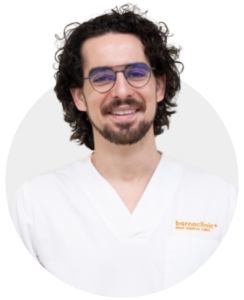 “What will change is the type of treatment we use depending on each individual case.”
Dr Francisco J. Cuesta González, a specialist in facial paralysis surgery, is strengthening the surgical management of these patients at barnaclínic+, expanding treatment possibilities through a range of facial reconstruction and reanimation procedures.
These include nerve transfers, dynamic facial reanimation techniques, muscle transfers, static procedures to improve facial symmetry, and surgical procedures designed to improve eye closure. Treatment may involve a single technique or a combination of different procedures as part of a personalised surgical strategy.
Would you like to learn about the surgical options for facial paralysis?
Discover the different facial reanimation surgery techniques and the options available to restore movement, smile and eye closure and improve facial symmetry.
Facial reanimation surgery: restoring movement, not just symmetry
One of the options currently available is facial reanimation surgery, also known as dynamic facial reanimation surgery. Unlike static techniques, which reposition tissues and improve facial symmetry, dynamic surgery aims to restore facial movement.
“Facial reanimation surgery is what we call dynamic surgery.”
Dr Francisco J. Cuesta González
Specialist in Oral and Maxillofacial Surgery at barnaclínic+ and Hospital Clínic Barcelona
To achieve this, new connections can be created to provide nerve signals to muscles that are no longer receiving the facial nerve signal correctly. Depending on the patient, this stimulation may come from different nerve sources.
One of the developments in this type of surgery involves combining different sources of nerve stimulation to achieve increasingly physiological facial movements. The choice will always depend on the type of injury and each patient’s potential for recovery.
Ver esta publicación en Instagram
Timing is an important factor in recovery from facial paralysis
Not all cases of facial paralysis that initially fail to recover require surgery. During the early stages, medical treatment, eye protection, follow-up and specialist facial paralysis rehabilitation may be indicated.
However, when recovery is not progressing favourably, a specialist assessment can determine the condition of the nerve and facial muscles and identify the treatment options available.
“The time since onset is crucial.”
Dr Francisco J. Cuesta González
Specialist in Oral and Maxillofacial Surgery at barnaclínic+ and Hospital Clínic Barcelona
Over time, muscles that no longer receive nerve stimulation may progressively atrophy. This does not mean that long-standing facial paralysis cannot be treated, but it can affect which surgical techniques can be used.
While some patients retain facial muscles that can receive nerve stimulation again through reinnervation techniques, in other cases muscle transfers or static procedures may be more appropriate.
For this reason, when facial paralysis is not progressing favourably, specialist assessment is recommended without necessarily waiting for the condition to be considered permanent.
Restoring the smile after facial paralysis
One of the consequences that can have the greatest impact on a patient’s life is the loss of their smile. However, facial paralysis goes far beyond an aesthetic issue.
The face plays an essential role in communication and emotional expression. Difficulty smiling, controlling saliva or making natural facial expressions can cause discomfort and lead some people to progressively reduce their social interactions.
“Our face is how we present ourselves to other people.”
Dr Francisco J. Cuesta González
Specialist in Oral and Maxillofacial Surgery at barnaclínic+ and Hospital Clínic Barcelona
Restoring the smile may require different strategies. When the facial muscles are still able to respond, nerve transfers can provide a new source of stimulation. In other patients, functioning muscles such as the temporalis muscle can be used to restore movement to the corner of the mouth.
In addition, surgery and rehabilitation are part of the same treatment process. After a new nerve or muscle pathway has been created, the patient requires a specific rehabilitation programme to learn how to use it and progressively integrate the new movement into their facial expression.
Treatment of facial paralysis after acoustic neuroma and other surgical procedures
Patients who may require specialist treatment include those with facial paralysis following surgery for an acoustic neuroma, other skull base tumours, trauma or complex head and neck surgery.
In these cases, a multidisciplinary approach makes it possible to assess the different effects of the injury and select the most appropriate treatment options. At barnaclínic+, specialists in Oral and Maxillofacial Surgery, Plastic and Reconstructive Surgery, Neurosurgery, Physical Medicine and Rehabilitation, Neurology, Ophthalmology and Otorhinolaryngology (ENT) work together in a coordinated manner.
This approach addresses not only smile restoration but also other consequences of facial nerve injury, such as facial asymmetry at rest or the inability to close the eye completely.
Realistic expectations and personalised treatment
The results of facial paralysis surgery depend on multiple factors: the cause of the injury, the time since onset, the condition of the facial nerve and muscles, previous procedures and the surgical technique required.
For this reason, a fundamental part of the assessment is to establish with the patient which functions may be restored and what realistic outcomes can be expected from treatment.
Dr Cuesta particularly emphasises the importance of explaining the potential improvements and limitations of each treatment before recommending surgery. When recovery is possible, seeing movement return to a face that has remained paralysed for months or years can have an impact that goes far beyond the physical outcome.
A comprehensive approach to facial paralysis at barnaclínic+
By strengthening these surgical options, barnaclínic+ expands its comprehensive approach to facial paralysis and the treatment possibilities available to patients who do not adequately regain facial movement or who have persistent effects.
The model integrates specialist assessment, facial rehabilitation, facial reanimation surgery and functional follow-up, with coordinated participation from specialists linked to Hospital Clínic Barcelona.
This approach makes it possible to select treatment according to each patient’s stage of recovery: from management and rehabilitation during the early stages to different reconstructive options when it is necessary to restore movement, protect the eye or improve facial symmetry.
Restoring your smile starts with a specialist assessment
If you have facial paralysis that has not progressed favourably, our team can assess the condition of your facial nerve and muscles and determine which treatment options may be appropriate for you.